How many people get to live their dreams? I am..........!

This is my story from the time when Capt'n John and I first decided to sail around the big block, to circumnavigate this great land of ours, AUSTRALIA.


Sunday, 17 June 2012

Off to the Whitsundays


Friday 15th June 2012
Off to the Whitsundays
Pentecost I, Hamilton I, Fitzalan Beach Anchorage, Solway Passage, Whitehaven Beach Anchorage
20’26.098 S – 149’02.622 E
Little to no wind, calm seas warm sunshine
Sunrise at Gap beach Lindeman Island
This morning MrJ and I waved goodbye to Gary and Mercedes on Forever Dreaming we all sailed out of the anchorage in Gap Beach on Lindeman Island. Ric and Shelly on Neriki will be sailing out soon: Shelly to catch the plane out of Hamilton and Ric to make his own way for the next two weeks while Shelly pays a visit back home. This morning we too will be moving on, moving to our next anchorage and our next adventure.

For all three boats, this is the beginning of their own exploration of the Whitsunday Islands. Who knows, we may meet up again somewhere around the corner to enjoy more adventures together.
Neriki sailing past Pentecost Island
MrJ and I motored around to the NW side of Lindeman, Boat Port Bay; the wind and swell was coming up from the SSW so this anchorage was out of the question. We then turned about to head northward, heading towards Hamilton Island. MrJ was thinking that the anchorage on the other side of Hamilton, on Whitsunday Island in the Fitzalan Passage called Fitzalan Anchorage (20’29.596 S – 149’02.839 E) might have been a good spot to drop the anchor to do his internet business. I set the anchor and we waited for the boat to settle. The wind was bulleting around the horn on Hamilton Island push our stern to the coral shore. Not liking to be on a lee shore especial it being that nasty boat-biting coral stuff; MrJ and I decided it was better not to stay here so I pulled up the anchor and we were off again.

This time it was a great sail across the passage at the bottom of Whitsunday Island, past Turtle and Chance Bay with a 20knt wind on the beam and a fast running sea. Around the bottom of the island and through Solway Passage where the wind abated and the pass was smooth with an outgoing tide. Once through the pass MrJ steered AR into the calm waters off Whitehaven Beach. Guess who was also there? Forever Dreaming! I bet that they thought that we were following them. They didn’t and were glad to see us.
Suset play on the Whitehaven Beach
MrJ and I anchored AR a fare distance along the beach from where all the tourist and charter boats had anchored and Forever Dreaming was right smack bang in the middle of them all. Later that afternoon when we caught up with Gary and Mercedes for drinks on the beach, Mercedes said that it was rather fun being in a mongst it all getting to see and hear all the goings on. While on the beach having Sundowners we also met Jeremy and Iona and their three girls. MrJ and I had met Jeremy and one of his daughters at Shaw Island and now we were able to meet the whole family with Jeremy’s mum and dad too. The little girls had become so accustomed to boating life in their short six month of sea life on board that it showed in everything that they would do. Things like help haul in the dinghy, tie a line off and general running about their 50foot catamaran. It was amazing to watch them playing on the beach together; finding anything to play with, not bringing their own toys and such but finding an old length of rope and making an afternoon of fun while we waited for the setting sun.
Seeing these girls brought thoughts of my own dear grandchildren so many miles away.

Exploring Lindeman Island


Thursday 14th June 2012
Exploring Lindeman Island
Lindeman Island Resort, Public Jetty, Mt Oldfield, Gap Beach Anchorage
20’26.098 – 149’02.622
Very little wind WSW, warm sunny day
Looking down from MtOldfield at old resort and out boats at anchor
MrJ and I left Burning Point Anchorage Shaw Island at 0905h hoping to catch a little bit of wind to get a sail up going across to the southern end of Lindeman Island. We started out with just the genoa out but had to pull her in when the wind dropped off completely making us use the iron sails. We dropped anchor in 11mts of water just east of the public jetty near the now closed resort on Lindeman Island.
Closed resort
How many island resorts have I seen closed? Heaps!

Neriki and Forever Dreaming were not far behind and as soon as we had all settled at anchor – Forever Dreaming did pick up one of the X-resort mooring as it was too deep for them – we dinghied ashore to go hike Mt Oldfield. The climb up the steep road out of the resort area was a bit of a shock to start out hike. It was one of those “straight up” kinds of inclines and we all felt it, we felt like there was not a fit bone in our bodies. Once conquering the incline it was not such a bad hike of 7ks round trip taking us 2 ½ hours to do the trail with a good stop at the top of MT Oldfield to admire the wonderful 360* view. We passed through part of the X-resort, past some of the disused accommodation blocks, past the tennis courts and the archery field which didn’t look too run down. Then was walked along the road that ran beside the airfield before turning off onto a bush track, that had overgrown slightly, which led us down over a wooden walkway which crossed a creek where the trees were filled with the noise and smell of fruit bats. The bats took to the sky in fright as we past underneath and no one was game to look up in fear that they would get peed in the face. No one got peed on, thank goodness!

Up the hill

We walked on along the overgrown track, through dry bushland, through semi tropical rainforest and then out into grassland as we neared the top of Mt Oldfield. Throughout the grassland at the top were hundreds and hundreds “black boys” or to be politically correct, Grass Ferns with tall flowering stems. But the view was what we were there to see and it certainly did not disappoint any of us.


The view
The view from the top of Mt Oldfield was truly 360*; looking as far north as Whitsunday Island, west to the mainland, south down to Brampton Island and east all the way out to sea. How spectacular!
Looking towards Shaw Island
After our fabulous hike and back on board it was time to way anchor and mover around the Gap Beach (20’29.596 – 149’02.839) on the NE side of Lindeman Island for a better protected calm anchorage for the night.

Wednesday, 13 June 2012

Shaw Island


Wednesday 13th June 2012
Shaw Island
20’30.274 S – 149’02.813 E
Warm days and cool nights, gentle breezes and no swell

Shaw Island
0800h saw all three boats Alana Rose, Neriki and Forever Dreaming make a move out of the Goldsmith Island anchorage; out and away from the rolly anchorage and sailing not too much further north to the beautiful Shaw Island.

We are now anchored off the south western beach around the headland of Burning Point. It is certainly a much better anchorage with no swell coming around the point, not the rolly action of the sea. Burning Point is an attractive anchorage at the southern end of Shaw Island. The anchorage area is best at 5-12mts to the East of the very tip of the Western point. Datum depths here range from 2 to 8 metres with a grassy bottom. Be sure to not anchor too close to shore. The anchorage is good for East to South West in light to moderately to strong condition, fishing is permitted and it offers great sunset viewing over Lindeman Island.
Rock Cairns
MrJ and I spent yesterday, Tuesday, exploring the beaches and the rocky sea made passage between Burning Point and the island. This passage is where over many years, the boating fraternity has build a multitude of rock cairns. It has become a real tradition to either build your own or add to one of the others; I added to one of the existing cairns.

The beaches at Shaw Island are pristine and very approachable in your dinghy as the tide floods. The grassy bottom in the anchorage also is the home for sea turtles. We kept a good look out and did see a couple breaking the surface for more air as we passed in our dinghy. Beach access is restricted during the months of October to March due to breeding cycles of the Beach Curlew.
Pristine beach
Today was washing day. MrJ pulled the small twin tub plastic washing out of our storage room which I call “the laundry” just because we store the machine in there. MrJ does the washing as it is manual loading of the water while I made a loaf of bread and a small cake for smokos. Tomorrow we will go exploring again.

Goldsmith Island


Monday 11th June 2012
Goldsmith Island
20’40.218 S – 149’08.950 E
Warm days, cool nights, moderate breezes 10/15 gusting 20knts
Goldsmith Island Anchorage
0625h MrJ and I motor sailed across to Goldsmith Island; taking just over three hours to do the 20n/m. I could see the sails of Neriki coming upon us fast from the south where they and Forever Dreaming had left Brampton Island.

MrJ and I dropped the pick in the first southern bay on Goldsmith as Neriki rounded the headland. We had anchored too close to a bommie and the swell was coming around the headland; not happy with that at all so we pulled the anchor up and move further north to the second bay hoping to get a better spot. Neriki did the same and was not long followed by Forever Dreaming.

The sea must have been still stirred up by the terrible low pressure system off southern Queensland as the swell was running strongly around the island and into all the bays. The wind was more to the S and a little SW which brought the chop into the bay at times making the anchorage rather rolly especially if the boat was copping it on the side.

Never to be deterred, before lunch, MrJ and I went ashore to stretch our leg and explore the beach. There was a lovely long white sandy beach with gentle wave on the shoreline, rocky headlands at both ends with tall Hoop Pines, small She-oak trees to give shade and a camping site with a drop-dunny hut and heaps of wild flowers. But now walking track!
Southern headland
She-oaks - As soon as the name She-oak is mentioned, as is the case with the Gum tree, any fair dinkum Aussie knows exactly what plant you are talking about. But few would know that these strange and mysterious trees possess both real and imaginary powers and maybe one of over 40 species in Australia and the South Pacific.
She-oak bushland
The She-oak family is a highly evolved family and is closely related to no other. They have achieved specialisation in isolated conditions such as exposed, sandy coastal foreshores, riverbanks, dry grassy woodlands, desolate rocky sites or swampy riparian flats. Its generic name Casuarina or Allocasuarina ("Allo"meaning like the casuarina) refers to the fine filamentous branches, which resemble the cassowary's quills. It is also noted that early Australians referred to casuarinas as Australian "Pines". The verticillata in Allocasuarina verticillata relates to the whorled arrangement of the leaves around the stem, (as in bike spokes). The word She-oak comes from the recognition by the early colonial craftsmen that an inferior (in their opinion) oak grain could be achieved by cutting the she-oak logs on the quarter (a specialised saw milling technique) and using the wood for crafting etc.

An architect could not have done a better job of designing these plants for the extreme environmental conditions in which they thrive. The long drooping branches consist of myriads of finer branchlets. The leaves are reduced to ribs on the branchlet, which end in leaf teeth. These reduced leaves occur in whorls located at the evenly spaced joints along the branchlets. These green branchlets perform the same food-making role (photosynthesis) as the leaves, but save on water losses, by reducing transpiration. The trees are endowed with a tough corky, corrugated bark, ideal as a protective shield from the abrasive, sand laden coastal winds. The trees have two distinct forms, either male or female (dioecious). The male tree has long reddish flowers at the ends of its branchlets, which pollinate the rusty red, globular flowers on the female tree. The female's flowers are designed to hang well out to catch the wind born pollen grains that wafts pass from the nearby male. The production of pollen can be so prolific that they often produce a reddish carpet of pollen under the trees.

The fruit resembles brown cones with valves (look like little beaks) opening to produce shiny black seeds. The cones can be assisted to release the seed, by selecting ones that have closed valves, and storing them in a paper bag for a few weeks, until the beaks open to release the seed.
Wildflowers and butterfies
The mysticism of She-oaks relates to the Tahitians, who believed that they arose from the warriors who died in battle, killed by clubs or spears made from its very hard wood. The warriors hair became the foliage and their blood oozed forth once more as the red sap. However, for the colonists, they saw the superstition and mythical nature of the tree in its ability to support the parasitic mistletoe, since it commonly sprawls over and sometimes smoothers this tree. The Australian southern states mistletoe (Amyema sp.) has a remarkable ability to mimic the host she-oak so much so that they are very hard to tell apart. The authenticity of the suspect plant is given away by watching the mistletoe bird feeding on its glutinous berries. The seed passes through the bird's unusual gizzard in 30 minutes and lodges on another She-oak branch. Its green shoot then suckers into the bark, with the help of its enzymes, that breakdown the bark and wood. A broad range of nectar feeding birds pollinates the mistletoes. These include unlikely species such as the cuckoo-shrikes, ravens, cockatoos, shrike thrushes and even wood swallows. They also provide nutritious fruits for the birds to feed on, which is a separate activity to the dispersal role that the mistletoe bird performs. The She-oak's life history is a construct of the fire regime to which it has been subjected. A fire regime is made up of the frequency of the firing (years between successive fires), the season of the fire and the intensity of the fire (relates to the amount of fuel available and moisture levels in the soil and surrounding air). The She-oak is an excellent example of how an individual plant's life history changes depending on the fire regime applied. The response mostly relates to the intensity of the fire as described below.

  • For a low intensity fires or cool burns, the older trees are unaffected, whilst the younger plants are killed. However, they will re-sprout from their bases. Cool burns do not release the seed stored in the cones within the canopy.
  • For a moderate intensity fires, the younger plants are killed and they mostly do not re-sprout. The mature tree survives, but some of their canopy dies releasing a small amount of seed from the cones.
  • For high intensity fire or very hot burns, all She-oaks are killed outright with their survival relying on the release of the seed stored in the cones within its canopy (where it maybe stored for up to 10 years).

She-oak trees, which are killed by hot fires, shed their seed. These will only stay viable for less than 3 months in the soil. With suitable conditions, prolific germination occurs after a hot fire on the sterile nutrient rich ash bed. (Provided that the harvester ants do not grab them first). Once successfully germinated, the dense mass of seedlings crowd out other native plants, which may germinate. It needs to be remembered that, young She-oaks need to have at least 5 to 7 years of growth before they start to produce seed bearing cones and at least 10 years before they have a reasonable number of cones in their canopy. If no further hot fires occur the She-oak community dominates the area once again. If two hot fires occur within 7 years then the She-oak woodland will be replaced by grassy woodland.

The craft wood potential of the hard, beautifully grained, reddish timber was recognised by early settlers. Its attributes ensured an export market to the mother country. Here it was treated as a prized wood, only to be used sparingly on highly prized projects. Small artefacts such as document boxes or inlaid features in fine quality furniture were crafted from this imported She-oak. The strength of the wood proved useful to colonists for crafting axe handles and other tool handles. Today the wood has once again been recognised for its qualities to the point where a few plantations of She-oaks have recently been planted. These plantations also benefit the apiary industry as the flowers' pollen attracts honeybees, which produce a distinctive tasting honey. She-oak was also noted for its firewood property of burning very hot, leaving a pure white ash bed. This white ash proved ideal as a sheet whitener, prior to commercial whiteners. This ash also comprised the major component in soap, forming the "Li" or alkali which, when mixed with animal fat (Sheep or Roo origins) and scented with rose water, chemically combined to form real true blue soap. She-oak was popularly used for making spears. The inner bark and sapwood shavings were soaked in water and the liquid gargled for toothaches.

Aboriginal tribes used the She-oak trunks for attracting grubs. The trunk was dumped into creeks and rivers to attract grubs. These were harvested and eaten raw or cooked. The young She-oak cones were chewed to promote salvia in dry mouths, as they travelled long distances through the hot, dry landscape. Exudates collected from the trunk were chewed or melted with warm water to form a jelly prior to eating.


Sunday, 10 June 2012

Still at the Newry Islands


Sunday 9th June 2012
Still at the Newry Islands
Cool, cloudy, windy (15/20knts) and a little choppy on the water
Concertina Rock, Outer Newry Island & Wedding Cake Islet 
Here we are still anchored between Newry and Outer Newry Island when our mates off Neriki and Forever Dreaming have sail out to Brampton Island. The weather has set in for a few days and MrJ and I chose to stay put rather than go. We have been to Brampton before, a couple of times and I know that it is another beautiful island worth exploring but sitting in the Newrys is a much better option in my books.

Thursday MrJ and I went for morning tea on Forever Dreaming, Mercedes and Gary’s boat, an eleven metre Easy that he built himself. What a lovely boat with a great finish and fresh feel.

After morning tea all of us, me and MrJ, Gary and Mercedes and Ric and Shelly, took the dinghies across to the rocky landing on Outer Newry Island enabling us to walk the short track over to the other side of the island. It was nearly high tide which made it very easy to get ashore but shoes were a must for the hiking and getting over the slippery rock at the water’s edge.
Wearing his best socks


The track across Outer Newry Island is well marked, leaving the camping ground area where there is an old fishing hut, picnic table, a water tank and two loos, male and female. The loos are pit type (hole in the ground) in a modern out-house structure. Most of these types of modern pit loos are self decomposing which is far better than the old hole in the ground of days gone by.

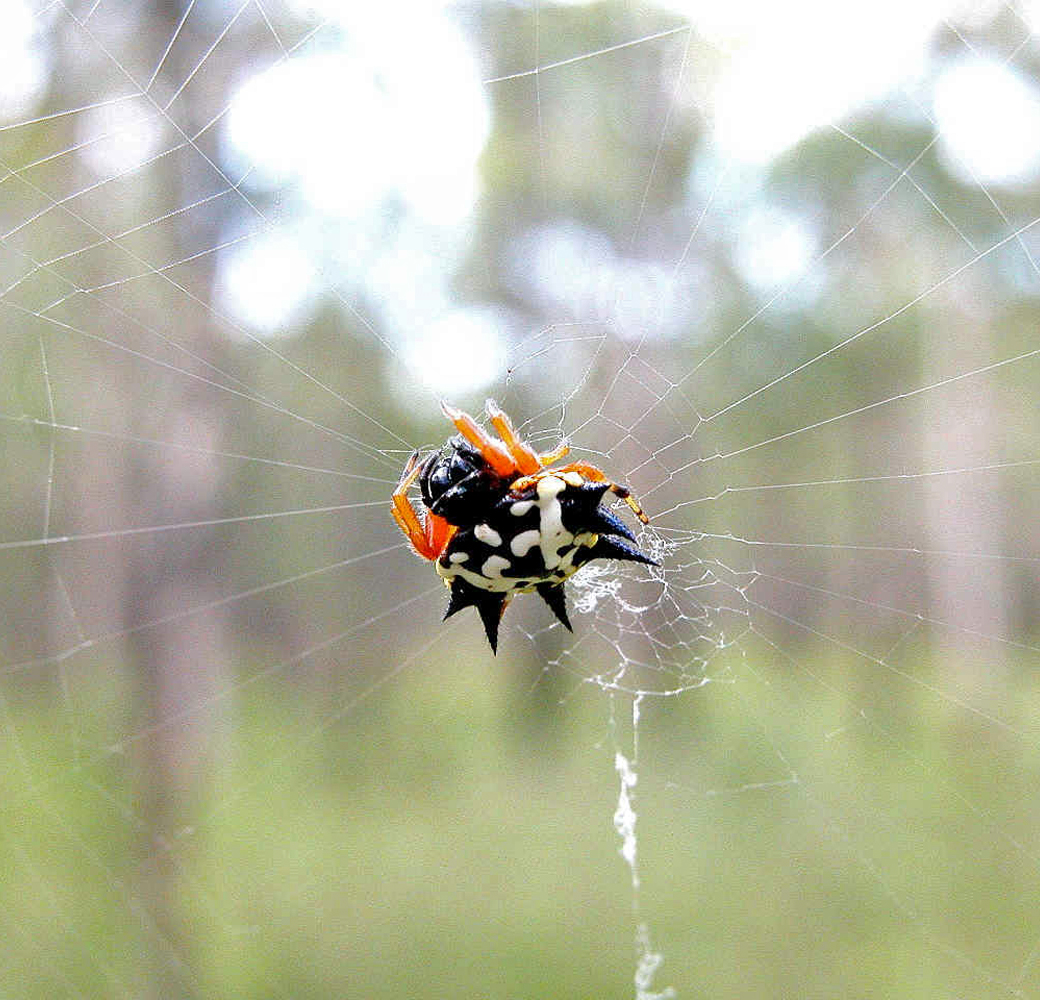
Following the track to the other side of Outer Newry Island I found more evidence of the digging wild life on the island and lots of Jewelled Spiders.

Jewelled Spider
Jewel or Spiny Spider - female: 8 mm, male: 4 mmThe ring of black spines around the abdomen and the distinctive yellow, white and black markings make this spider easy to identify. In some parts of Australia the common name for this species is the Christmas spider because it is most often noticed in December and January. However, with diligent searching it can be found from November to about May. I was very lucky to see these spiders at this time of year. This spider builds a small circular web between shrubs. Although sometimes this spider's web is reduced to a few supporting strands.

Over on the other side of Pouter Newry Island is a large stony beach area; to the west of this beach is Concertina Rock and to the east is Wedding Cake Islet.  The boys tried to walk across all those stones to get a better look at Concertina Rock but found the going too tough and came back. We decided that it was a much better idea to return to our dinghies to motor around the western point for our better view.
Stony beach
Lunchtime found our happy cruisers at the campground and old resort area on Newry Island once again. Picnic bags full of lots of goodies were spread across the table. Ric supplies the gas BBQ for our meat and everyone else brought enough food to feed an army and an army’s appetite we all had after our trekking and exploring most of the morning.

After lunch I went off to take a few shot of the ruins, the old resort building or what is now left, main brick and stone rubble. These shots will make very interesting black and white photos. Yes I know – as MrJ always says – I’m obsessed with my photographer. More like an addition, I think!
Picnic area
Friday morning the mates sailed out, Neriki and Forever Dreaming leaving Alana Rose behind, leaving MrJ and me to be “Darby and Jones” once more.

Being “Darby and Jones” is something that I have become accustomed to over the five years plus some that MrJ and I have been living on the water. I was introduced to this way of life when we chose to buy our boat home, Alana Rose, in another country and we had to get her home back to OZ somehow. The sailing passage through the Caribbean waters, through parts of South and Central American waters, through the Panama Canal and then all the way across the great Pacific Ocean to Australia was a fabulous adventure with many stop-offs at many wonderful, exciting and romantic places. Visiting all these magic places was the holiday; sailing the passages was the work and some of the work was very hard and at times was even scary. By the end of this passage the work became less stressful as I had learnt more ways how to hand not only the physical side by my own personal outlook, feeling and stresses.
The old Brady's Cabin
I was never lonely and am still not; there is always something new to see or do every day. I have learnt to be more “still”, to chill, to relax more and to find smaller things to do when confined to my home in bad weather which is not much different to a land person on rainy days. Besides doing the continuing cleaning chores I cook, knit, crochet, write, take pictures and play on the computer when the power lets me. When the weather is fine I go ashore to explore, walk the trails, take pictures or paddle my kayak to interesting shorelines. Sometime I have the company of other cruising and boating people, sometimes not. Most times it is just MrJ and me as “Darby and Jones”, all alone.

We are left at the Newry’s anchorage with two other small sailing boats. Two local boaties that I assume live in this anchorage for most of the time maybe to return to somewhere now and again for their supplies. I have waved to these two old sailors when I see them go by which is hardly ever; one has a small wooden row boat the other has a rubber duckie (rubber dinghy) with a motor. I never see either of these sailors on deck except when there is a need for one sailor to call out to his mate. One afternoon the row boat sailor went over to visit the rubber duckie sailor, who I have since heard him being called Pat. Pat the Rubber Duckie Sailor! Another day the two old sailors took a rolled sail over to the campsite; maybe to do some repairs. (???) Since the weather has turned inclement the old sailors stay below in his own boat only to surface once a day to have a quick slosh down out of a bucket  while standing in his own tint cockpit. They would get their fresh water supply from the rainwater tanks at the National Park’s campsite on the islands. Freezing!
The anchorage between Newry & Outer Newry Islands
Last night, Saturday, there was a small fishing boat camped on the northern side of the Newry Island campgrounds near the old resort area. They had a big campfire lit down on the beach where they would be protected from the southerly winds. Pity our boat was moving so much with the winds, the fire would have made a great photo.

Tonight a foreign boat sailed into the anchorage and parked right behind AR. What a pity that we are leaving in the morning. MrJ and I are planning a sail across to Goldsmith Island where we should meet up with Neriki and Forever Dreaming.